
↑↓ navigate ↵ select esc close
Globe Wernicke History
A WORLD OF BEAUTIFUL, USEFUL & INTERESTING ANTIQUES,
ART, DECORATIVE & VINTAGE OBJECTS
What are you looking for?
Popular searches
the Antique warehouse Since 2001
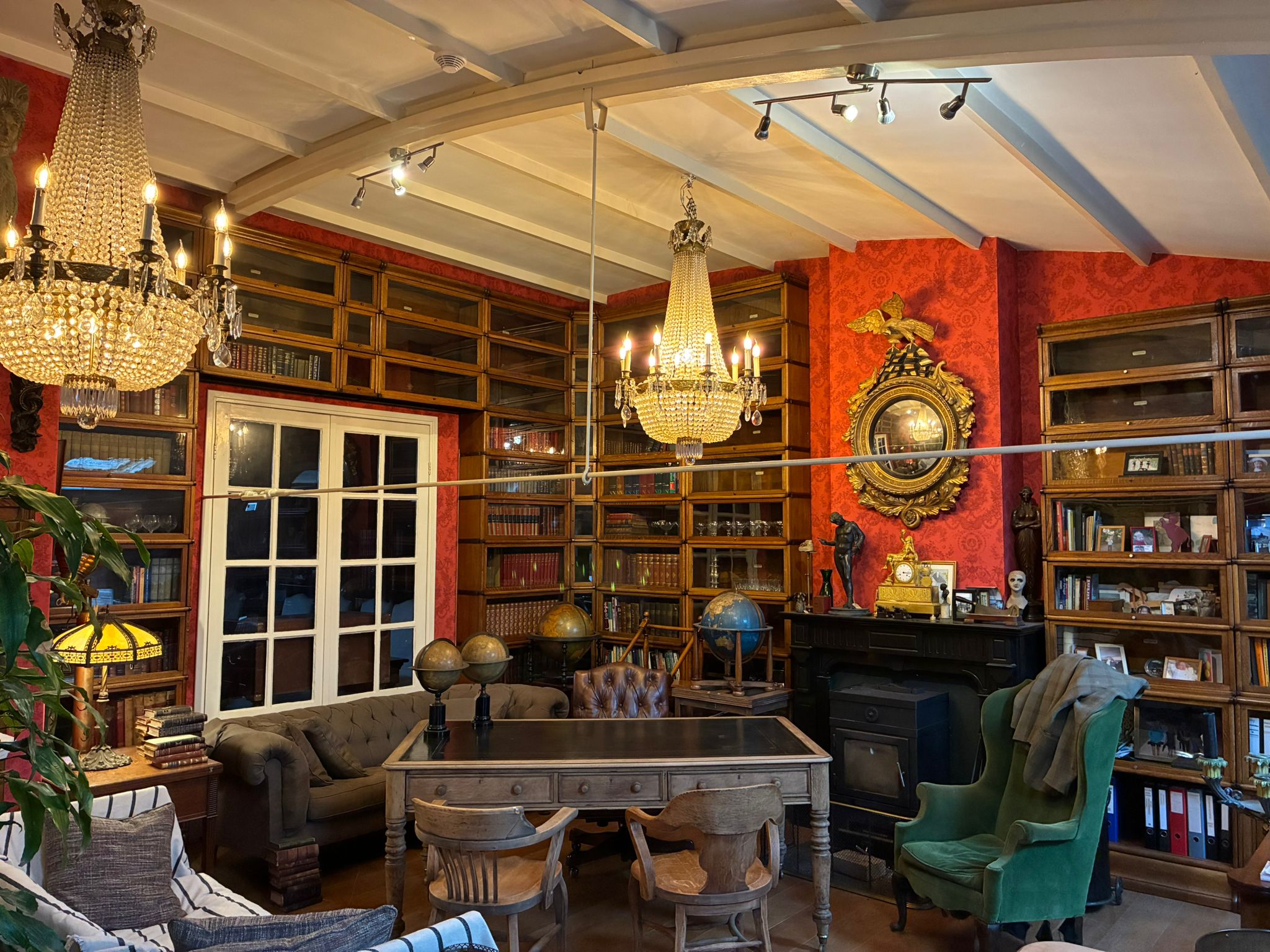
The GLOBE WERNICKE, Elastic Bookcase — The history of the Globe Wernicke bookcase system.

1890
The idea of the stackable bookcase, “the sectional Bookcase,” comes from Otto Heinrich Louis Wernicke, born June 18, 1862, and died August 20, 1930 (68 years old). He was an inventor and entrepreneur of German descent, born in Hayton, Calumet County, Wisconsin, USA. Around 1890, he founded the Wernicke Company, based in Grand Rapids, Michigan.
December 6, 1892
First patent application for the very simple bookcase that he named “SECTIONAL STOCK BOOKCASE.” It was a primitive version of a system bookcase and consisted of simple rectangular boxes with an opening, a partition in the middle, and two slots as openings for handles on the sides. He opened a small workshop in Nicolet Island in Minneapolis where he had these book boxes manufactured. These Sectional Stock-Case cabinets proved to be a solution for professions that frequently moved and had many books, folders, and a large amount of paperwork.
Initially, a lot was advertised in the North Western Law Reporter, resulting in significant sales to lawyers, which led to the nickname ‘barrister bookcase‘: lawyers’ cabinets.
The first library of the Wernicke Company was manufactured for Judge Alexander M. Harrison: the approximately fourteen meters (42 feet) of shelf space cost him twelve dollars, a fraction of what a custom-made, traditional bookcase would cost. For this market, the simple boxes quickly became insufficient, and there was a demand for better-finished cabinets. Glass front panels or doors provided better dust protection, and decorative edges, bases, and caps made an office suitable as a reception area for clients.
December 6, 1892
The U.S. government granted the first patents for the modular bookcase system of Otto H.L. Wernicke. This described the stacking system consisting of loose elements that together formed a bookcase.
April 7, 1896
Patent granted for the improved version of the sectional bookcase, US Patent Number 557,737; these are very detailed drawings, connections, with descriptions and measurements of the bookcase. You can view the original documents and drawings of Mr. Wernicke’s design via the Wernicke-us557737A patent page on Google Patents.
example of drawings included in the US patent file,


Here you can see that every tiny little component, connection, or measurement was described.
1899
Henry C. Yeiser, who was in the filing cabinet business, became interested in the design of the Wernicke Co., namely the stackable bookcase, and either bought or merged with them; this is still unclear to me. Under the new ownership or the new partnership, the factory was renamed the Globe Wernicke Company and was located in Cincinnati (Ohio). This businessman, born December 19, 1852 – died May 28, 1940, lived to be 87 years old, founded The Globe Company on February 8, 1882, at the age of 30. This initially small workshop grew into a true factory that provided for the storage of documents. The Globe Co. became one of the largest manufacturers of various document and file storage systems. The collaboration between Wernicke Co. and Globe Co. went well from the start, and the cabinets were renamed the strong brand, THE GLOBE-WERNICKE Co. Thus, now under the new management of the original Globe Co., which marketed the products not only in the United States but also abroad as The Globe-Wernicke Company
Henry Yeiser made significant improvements to Wernicke’s designs, allowing the company to market a balanced, contemporary system bookcase, the so-called Elastic Book Case. Because a patent was immediately applied for every improvement, the Globe-Wernicke Company was able to take the wind out of the sails of the usual competition. See also the lawsuit in 1902 Globe Wercke versus Fred Macey (also a stackable bookcase system) over copying the cabinet. Competitors were eager to get a piece of the sales successes but had to watch helplessly as the company grew into a thriving business. On the other side of the ocean, Thomas Turner was attracted by the success and innovative design of the flexibility of the bookcase system.
1899
In this year, 1899, Thomas Turner in England began producing Globe-Wernicke cabinets under license. The new company, The Globe – Wernicke Co. Ltd, started in London, 222 Kensal Road, London W 10. This became a great success in Victorian England. Partly due to the many colonies of the United Kingdom and the modular system, which was experienced as very pleasant for moving, still is by the way, the heavy bookcases were actually unsuitable for transport, the bookcases also became a great success outside the United Kingdom. The cabinets were also patented in Canada, France, Belgium, Austria, Germany, and Scandinavia. In these countries as well, the bookcases became a great success.

Turner had a world-famous customer, namely Lenin, who ordered a cabinet for his study in 1908. The system cabinets proved to be particularly well received in Victorian and Edwardian England. Luxury versions of the cabinet were equipped with a block list, pilasters on the styles, and a cornice with carved acanthus leaves, The Ideal Style.
All copies differed slightly from the original G-W cabinet. Often there was a different sliding system for the front panels or the steel coupling strips that allowed the cabinets to be connected were missing. The Globe-Wernicke company produced a large assortment and delivered the cabinets in various sizes.
In addition to the Standard version, there was also the sober Universal Style and the elegant Ideal Style Bookcase. Later, Globe-Wernicke and some competitors exported about eighty percent of their cabinets in steel. In 1955, the factory was taken over, only to be closed ten years later to make way for a parking lot for General Motors.
Below is an example of a Globe Wernicke sales brochure with all sizes, wood types oak or mahogany, and various types of glass, etc.


